May 8, 2026 · Anchorclick
How RAG Works: A Comprehensive Guide
RAG stands for Retrieval-Augmented Generation. It is a way to make AI answers more accurate by letting the AI look up relevant information before it responds.
RAG stands for Retrieval-Augmented Generation. It is a way to make AI answers more accurate by letting the AI look up relevant information before it responds.
Instead of only relying on what the AI already knows, RAG lets the system search through documents, websites, databases, or other sources. Then the AI uses that retrieved information to create a better answer.
For example, if someone asks, “What is our refund policy?”, the AI can search your company documents, find the refund policy, and then explain it in plain language.
Why RAG Matters
RAG is useful because AI models do not always know the latest or most specific information. They may also guess when they do not have enough context.
RAG helps solve this by giving the AI access to trusted information before it answers. This makes it useful for customer support, internal knowledge bases, research tools, AI search, and business automation.
What You Need Before You Start
Before using RAG, you need a source of information for the AI to search. This could be blog posts, help docs, PDFs, product pages, support articles, or internal company documents.
You also need a way to break that information into smaller sections. These smaller sections are easier for the AI system to search and use.
Finally, you need a system that can search for the most relevant pieces of information and pass them to the AI model.
Step-by-Step Process
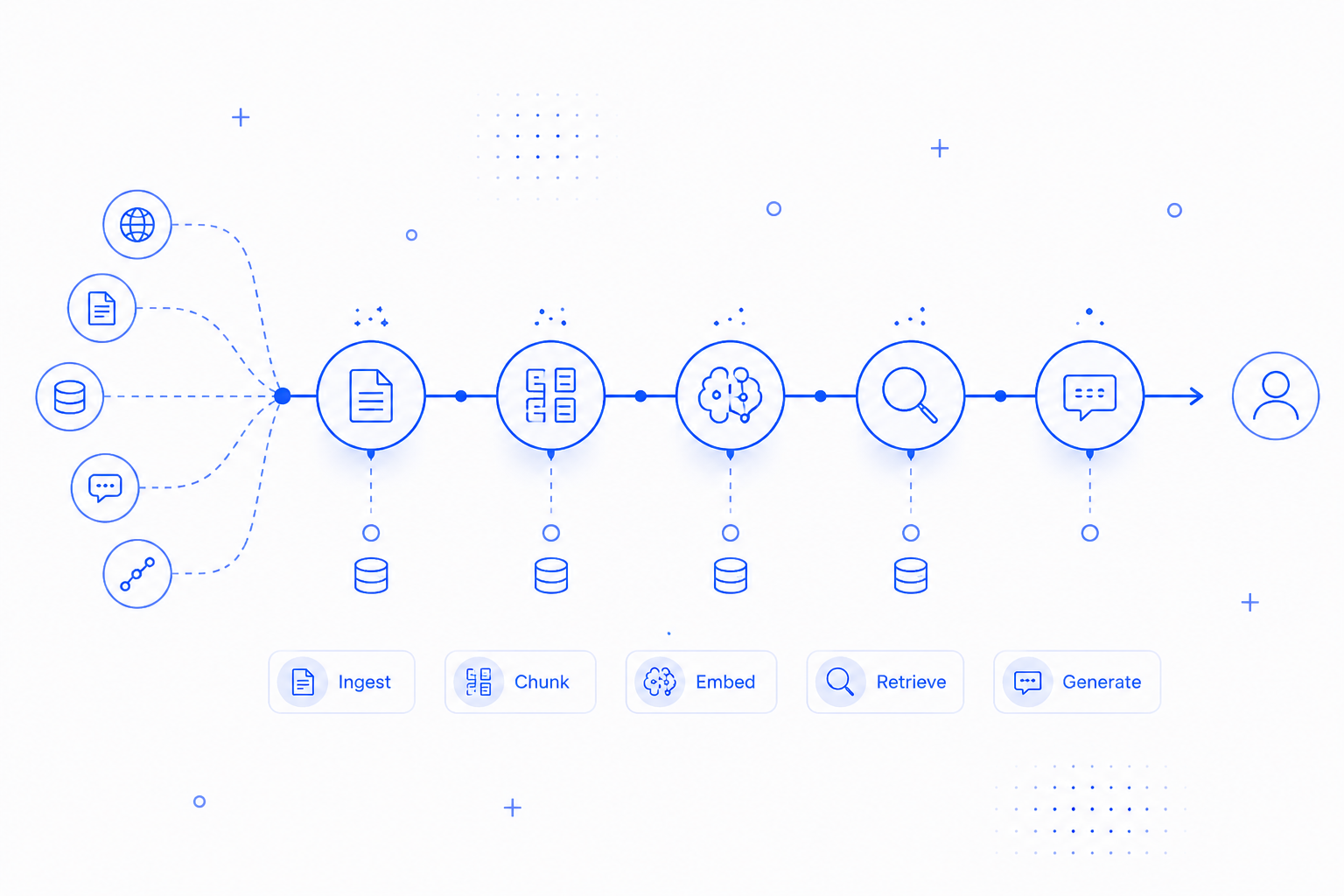
Step 1: Add Your Content
First, collect the content you want the AI to use. This could include website pages, documents, FAQs, or database records.
The cleaner and more accurate your content is, the better the AI’s answers will be.
Step 2: Split the Content Into Chunks
Large documents are usually broken into smaller pieces called chunks. Each chunk may be a paragraph, section, or short group of related sentences.
This helps the system find the exact information that matches a user’s question.
Step 3: Search for Relevant Information
When someone asks a question, the RAG system searches through the stored content and finds the most relevant chunks.
For example, if the user asks about pricing, the system should retrieve pricing-related content.
Step 4: Generate the Answer
The AI model then uses the retrieved information to write an answer. The goal is to answer based on the source material instead of guessing.
Common Mistakes
One common mistake is using low-quality or outdated content. If the source information is wrong, the AI answer may also be wrong.
Another mistake is adding too much irrelevant content. This can make it harder for the system to find the right information.
Poor chunking can also cause problems. If chunks are too large, the AI may get unnecessary information. If chunks are too small, they may lose important context.
Some systems also fail to show sources. Adding citations or source links can make RAG answers more trustworthy.
Tools for RAG
Common tools used for RAG include vector databases, document loaders, embedding models, and AI models.
Examples include:
- OpenAI embeddings
- Pinecone
- Weaviate
- Chroma
- LangChain
- LlamaIndex
- Supabase Vector
- MongoDB Atlas Vector Search
These tools help store, search, and retrieve relevant information before sending it to the AI.
Common Misconceptions
A common misconception is that RAG always requires a vector database.
In many cases, you can retrieve useful context from the systems you already use — a regular database, a CMS, a search index, or well-structured documents. If your content is organized and searchable (for example by keyword, category, product ID, or FAQ topic), a simple lookup can be enough to give the AI the right material before it answers.
Vector databases are helpful when you need semantic search — finding content that means the same thing as the question, even when the wording is different. They are not a requirement for every RAG project.
Start with the simplest retrieval method that reliably returns the right sources. Add embeddings and a vector store later if keyword or structured search is not finding the best matches.
How to Measure Results
You can measure RAG performance by checking whether the answers are accurate, useful, and based on the right sources.
Good questions to ask include:
- Did the system retrieve the right information?
- Did the AI answer the question correctly?
- Did it avoid making things up?
- Was the answer clear and helpful?
- Did users get what they needed?
Over time, you can improve results by cleaning your content, improving chunking, adjusting search settings, and reviewing failed answers.
Conclusion
RAG helps AI systems give better answers by letting them search trusted information before responding.
It is especially useful when the AI needs access to company-specific, current, or detailed information. With the right content and setup, RAG can make AI tools more accurate, useful, and reliable.